Today's
EarthStation1.com 15% Off Commemorative Memorial Title: Behind The
Horoscope: Validating Natal Astrology DVD, MP4, USB Drive
Today, April 20, 2026
April 20 - May 20 (2025): Solar Zodiacal
Transits: -- Taurus (Latin: "Bull"), the second
astrological sign in the Zodiac, is entered by the Earth's Sun,
which will transit the sign in 2021 until May 20, according to the
tropical zodiacal system. The ruler of the sign of Taurus is Venus
and the Moon is in its exaltation; traditionally Mars and in
modern astrology Pluto is in detriment, and in modern astrlogy
Uranus is in its fall. Taurus is one of the triplicity of
astrological signs of the element of earth, and as such a negative
sign, it is a passive, yin, feminine sign as one of the six
even-numbered signs of the zodiac - Taurus, Cancer, Virgo,
Scorpio, Capricorn and Pisces - all signs which constitute the
earth and water triplicities. Taurus is a one of the four fixed
astrological signs, also known as kerubic (or cherubic)
astrological signs, signs assigned to the middle of one of the
four seasons, and as such, Taurus marks the middle of spring in
the northern hemisphere, and the middle of fall in the southern
hemisphere, and signifies the zodiacal archetype of the entirity
of the season they represent. Fixed signs - Taurus, Leo, Scorpio
and Aquarius - are associated with stabilization, determination,
depth and persistence. On the other hand, those who hold this
astrological quality tend to also be inflexible, rigid, stubborn,
opinionated and single-minded. These traits are often paired with
the need to be considered "right": they will ruthlessly
fight on behalf of their beliefs, sometimes regardless of valid
contrary beliefs. Once set on a path, they are fiercely determined
and will not change course. Taurus spans 30 dg to 60 dg of
celestial longitude. Under the tropical zodiac, the sun transits
this area between April 19 and May 20 in 2021. In sidereal
astrology, the Sun currently transits the constellation of Aries
from May 14 and June 15 in 2021. The sign of Taurus is associated
with several myths and bull worship from several ancient cultures.
It was the first sign of the zodiac established among the
Mesopotamians, who called it "The Great Bull of Heaven,"
as it was the constellation through which the Sun rose on the
vernal equinox at that time, that is the Early Bronze Age, from
about 4000 BC to 1700 BC. There are varying beliefs about cattle
in societies and religions with cows, bulls, and calves being
worshiped at various stages of history. As such, numerous peoples
throughout the world have at one point in time honored bulls as
sacred. In the Sumerian religion, Marduk is the "bull of
Utu". In Hinduism, Shiva's steed is Nandi, the Bull. The
bull, whether lunar as in Mesopotamia or solar as in India, is the
subject of various other cultural and religious incarnations as
well as modern mentions in New Age cultures. The Sumerian guardian
deity called lamassu was depicted as hybrids with bodies of either
winged bulls or lions and heads of human males. The motif of a
winged animal with a human head is common to the Near East, first
recorded in Ebla around 3000 BCE. The first distinct lamassu motif
appeared in Assyria during the reign of Tiglath-Pileser II as a
symbol of power. In Egypt, the bull was worshiped as Apis, the
embodiment of Ptah and later of Osiris. The bull was also
worshipped as Mnevis, the embodiment of Atum-Ra, in Heliopolis.
The word Ka in the ancient Egyptian language is both a religious
concept of life-force/power and the word for bull. The cow goddess
Hathor was a major maternal goddess in ancient Egyptian religion
and in the Graeco-Roman world, and played a wide variety of roles.
Bulls were a central theme in the Minoan civilization, with bull
heads and bull horns used as symbols in the Knossos palace. Minoan
frescos and ceramics depict bull-leaping, in which participants of
both sexes vaulted over bulls by grasping their horns. The Iranian
language texts and traditions of Zoroastrianism have several
different mythological bovine creatures. One of these is
Gavaevodata, the Avestan name of a hermaphroditic "uniquely
created", one of Ahura Mazda's six primordial material
creations that becomes the mythological progenitor of all
beneficent animal life. Another Zoroastrian mythological bovine is
Hadhayans, a gigantic bull so large that it could straddle the
mountains and seas that divide the seven regions of the earth, and
on whose back men could travel from one region to another. The
Canaanite (and later Carthaginian) statue to which sacrifices were
burnt, either as a deity or a type of sacrifice - Moloch - was
referred to as a horned man, and likened to Cronus by the Romans.
There may be a connection between sacrifice to the Cretan horned
man Minotaur and Cronus himself. Both Ba'al and El were associated
with the bull in Ugaritic texts, as it symbolized both strength
and fertility. Among the Twelve Olympians, Hera's epithet Bo-opis
is usually translated "ox-eyed" Hera, but the term could
just as well apply if the goddess had the head of a cow, and thus
the epithet reveals the presence of an earlier, though not
necessarily more primitive, iconic view. Classical Greeks never
referred to Hera simply as the cow, but her priestess Io was so
literally, and it was in the form of a heifer that Zeus coupled
with her. Zeus took over the earlier roles, and, in the form of a
bull that came forth from the sea, abducted the high-born
Phoenician Europa and brought her, significantly, to Crete.
Dionysus was another god of resurrection who was strongly linked
to the bull. In a worship hymn from Olympia, at a festival for
Hera, Dionysus is also invited to come as a bull, "with
bull-foot raging." Quite frequently he is portrayed with bull
horns, and in Kyzikos he has a tauromorphic image. An archaic myth
states that Dionysus was slaughtered as a bull calf and impiously
eaten by the Titans. The religious practices of the Roman Empire
of the 2nd to 4th centuries included the taurobolium, in which a
bull was sacrificed for the well-being of the people and the
state. Around the mid-2nd century, the practice became identified
with the worship of Magna Mater (The Great Mother), but was not
previously associated only with that cult. Public taurobolia,
enlisting the benevolence of Magna Mater on behalf of the emperor,
became common in Italy and Gaul, Hispania and Africa. A
particularly important Roman mystery cult in which a sacrificial
bull played a role was that of the 1st-4th century Mithraic
Mysteries. In the so-called "tauroctony" artwork of that
cult (cultus), and which appears in all its temples, the god
Mithras is seen to slay a sacrificial bull. Amont the Celts, a
prominent zoomorphic deity type is the divine bull. Tarvos
Trigaranus ("bull with three cranes") is pictured on
reliefs from the cathedral at Trier, Germany, and at Notre-Dame de
Paris. In Irish mythology, the Donn Cuailnge plays a central role
in the epic Tain Bo Cuailnge ("The Cattle Raid of Cooley"),
which features the hero Cu Chulainn, which were collected in the
seventh century Lebor na hUidre ("Book of the Dun Cow").
Pliny the Elder, writing in the first century, describes a
religious ceremony in Gaul in which white-clad druids climbed a
sacred oak, cut down the mistletoe growing on it, sacrificed two
white bulls and used the mistletoe to cure infertility. The
practice of bullfighting in the Iberian Peninsula and southern
France are connected with the legends of Saturnin of Toulouse and
his protege in Pamplona, Fermin. These are inseparably linked to
bull-sacrifices by the vivid manner of their martyrdoms set by
Christian hagiography in the third century. On Sale @ 15% Off
Discount Till Midnight PT!
https://store.earthstation1.com/behind-the-horoscope-dvd-astrology-investigation-documentary.html
Today's
EarthStation1.com 15% Off Commemorative Memorial Title: Propaganda
Posters JPG Photo + MPG Video DVD-ROM Download
Today, April 20, 2026
April 20: Volunteer Recognition Day: --
Volunteer Recognition Day is observed every year on April 20. As
the name suggests, it is a day to honor, recognize and celebrate
the selfless individuals who volunteer their time and energy to
help others and promote good causes. Volunteers do all this
without expecting compensation or appreciation for their efforts
and this is what is so inspiring. Volunteers can be found in all
sectors, community kitchens, hospitals, retirement homes, or war
zones. Their selfless sacrifice deserves applause from the rest of
the world. As the name suggests, Volunteer Recognition Day is a
day to recognize, honor, and celebrate people who selflessly
volunteer their time, energy, and resources towards helping others
without seeking any compensation for themselves. A volunteer has
been defined by the Cambridge Dictionary as - "a person who
does something, especially helping other people, willingly and
without being forced or paid to do it." The act of
volunteering is perhaps as old as humanity itself - or close.
People have been offering to help and assist others in times of
need for eons. However, the word 'volunteering' made its first
appearance during the 1630s but only came into full use in 1755.
Then, it was construed in a military sense, referring to people
who volunteered to join the army. Indeed, the origin of organized
volunteering can be traced directly to wartime. Women would
volunteer to nurse wounded soldiers on the battlefield, while
others would put all their efforts into making uniforms for them.
One of the foremost volunteering organizations of all time, the
Red Cross, was also founded in response to war. Henry Dunant, who
had witnessed injured soldiers being left without adequate medical
support in the Battle of Solferino, couldn't help but take up the
matter. He wrote down his ideas in a book called "A Souvenir
of Solferino," which advocated that every army should be made
to care for wounded soldiers, regardless of what side they were
fighting for. Ever since, volunteering takes different shapes and
forms and transcends various industries. People volunteer to visit
old people, some work on weekends at community kitchens, while
others travel to foreign lands to help the needy. Volunteering is
a noble, worthy act that should be carried out by all of us. On
Sale @ 15% Off Discount Till Midnight PT!
https://store.earthstation1.com/propaganda-posters-cd-jpg-images.html
Today's
EarthStation1.com 15% Off Commemorative Memorial Title: Cathay
Videos: China VAV The U.S. Video Set DVD, MP4, USB Flash Drive
Today, April 20, 2026
April 20: Chinese Language Day: -- More
than one billion people speak Chinese in its Mandarin form as
their general language of choice. UNESCO (The United Nations
Educational, Scientific And Cultural Organization) first created
Chinese Language Day in 2010 to celebrate Mandarin Chinese as one
of the six official languages of the United Nations. The day also
celebrates Cangjie, who invented Chinese characters about 5,000
years ago. Legend says that when Cangjie finished, the gods rained
grain upon the earth. The Chinese language has existed for
thousands of years. Chinese formed from the Sino-Tibetian language
family. Due to its complexity, its origins remain unknown as to
when it separated itself from that family. It is believed however
that the origins of the Chinese language are credited to Cangjie.
They were one of the first official historians to invent Chinese
characters when the Yellow Emperor first began his reign. Despite
this credit, different dialects formed throughout the provinces of
China. Much of the influence of archaic Chinese, spoken during the
early and middle 11th to 7th centuries B.C., isn't seen much in
modern Chinese. During the Sui, Tang, and Song Dynasties or 7th
through 10th centuries A.D., connections can be made more easily
to modern Chinese languages. Distinct writing styles can be noted
thanks to historians during those centuries that served the
Emperors. Chinese Language Day is celebrated on this day to honor
Cangjie. Founded by the United Nations, Chinese Language Day also
celebrates multilingualism and cultural diversity. They aim to
educate people about the history of the Chinese language. Chinese
was established as an official language of the United Nations in
1946. In 1973, the General Assembly included Chinese as a working
language. Today, many members of the United Nations work with
Chinese as a functional language. They also aim to teach people
around the world the benefits that learning the Chinese language
can have. On Sale @ 15% Off Discount Till Midnight PT!
https://store.earthstation1.com/cathay-videos-china-vav-the-us-dvd.html
Today's
EarthStation1.com 15% Off Commemorative Memorial Title: Marihuana
(1936) Anti-Drug Propaganda Film DVD, Download, USB Drive
Today, April 20, 2026
April 20: 420 Day: -- 420, 4:20, or 4/20
(pronounced four-twenty) is slang in cannabis culture for the
consumption of cannabis, especially smoking cannabis around the
time 4:20 p.m. and also refers to cannabis-oriented celebrations
that take place annually on April 20 (which is 4/20 in U.S. form).
In 1971, five high school students - Steve Capper, Dave Reddix,
Jeffrey Noel, Larry Schwartz, and Mark Gravich - in San Rafael,
California, calling themselves the Waldos because "their
chosen hang-out spot was a wall outside the school", used the
term in connection with a 1971 plan to search for an abandoned
cannabis crop that they had learned about, based on a treasure map
made by the grower. The Waldos designated the Louis Pasteur statue
on the grounds of San Rafael High School as their meeting place,
and 4:20 p.m. as their meeting time. The Waldos referred to this
plan with the phrase "4:20 Louis". After several failed
attempts to find the crop, the group eventually shortened their
phrase to simply "4:20", which ultimately evolved into a
code-word that the teens used to mean consuming cannabis. Mike
Edison says that Steven Hager of High Times was responsible for
taking the story about the Waldos to "mind-boggling,
cult-like extremes" and "suppressing" all other
stories about the origin of the term. Hager wrote "Stoner
Smart or Stoner Stupid?", in which he attributed the early
spread of the phrase to Grateful Dead followers - after Reddix
became a roadie for the Dead's bassist, Phil Lesh - and called for
4:20 p.m. to be the socially accepted hour of the day to consume
cannabis. April 20 has become an international counterculture
holiday, where people gather to celebrate and consume cannabis. On
Sale @ 15% Off Discount Till Midnight PT!
https://store.earthstation1.com/marihuana-dvd-1936-antidrug-1936.html
Today's
EarthStation1.com 15% Off Commemorative Memorial Title: Monarchy
In The UK: British Royal History MP4 Video Download DVD Set
Today, April 20, 2026
April 20, 1653: The European Wars Of
Religion: The Wars Of The Three Kingdoms (The British Civil Wars):
The English Civil War: The First English Civil War: The Rump
Parliament: -- Oliver Cromwell dissolves the Rump Parliament as he
attended a sitting of Parliament and listened to one or two
speeches. Then he stood up and harangued the members of the Rump.
This speech does not survive but has often been paraphrased, for
instance in the Book of Days: "You have sat too long for any
good you have been doing lately ... Depart, I say; and let us have
done with you. In the name of God, go!". This admonition was
quoted three centuries later in the House Of Commons by David
Llyod George as a means of calling upon the then Prime Minister
Neville Chamberlain to resign in response to his troubled
leadership in the fight against Germany during the early days of
World War II; Chamberlain thereafter resigned, and Winston
Churchill became Prime Minister. The Rump Parliament was the
English Parliament after Colonel Thomas Pride purged the Long
Parliament, on 6 December 1648, of those members hostile to the
intention of the Grandees (senior military officers from the
landed gentry) to try King Charles I for high treason. "Rump"
normally means the hind end of an animal or backside; its use
meaning "remnant" was first recorded in the above
context in English. Since 1649, the term "rump parliament"
has been used to refer to any parliament left over from the actual
legitimate parliament. On Sale @ 15% Off Discount Till Midnight
PT!
https://store.earthstation1.com/monarchy-in-the-uk-british-royal-family-history-films-dvd.html
Today's
EarthStation1.com 15% Off Commemorative Memorial Title: New York
City History Documentary Collection MP4 Video Download DVD
Today, April 20, 2026
April 20, 1657: Freedom Of Religion
(Religious Liberty): The Jewish Diaspora: History Of The Jews In
The United States: History Of The Jews In Colonial America: The
Jewish Arrival In New Amsterdam: History Of The Jews In New York:
Jews In New York City: -- Freedom of religion is granted to the
Jews of New Amsterdam (later New York City). Jews began to
emigrate to New Amsterdam approximately three years earlier; on
August 22, 1654, Jacob Barsimson became the earliest identified
Jewish settler at New Amsterdam within the present limits of the
state of New York, and the first known Jewish immigrant to
America. Barsimson had been sent out by the Jewish leaders of
Amsterdam, Dutch Republic to determine the possibilities of an
extensive Jewish immigration to New Amsterdam. With the fall of
Dutch Brazil, it was imperative for Jews planning to leave Europe
to find other new homes. He arrived at that port on the ship Pear
Tree on August 22, 1654, having left the Netherlands on July 8.
Barsimson was succeeded by a party of 23 Jews, who arrived at New
Amsterdam in September, from Recife, Brazil, and established the
first Jewish settlement in what would become the United States. In
1658, Barsimson succeeded in securing from the Dutch municipal
court in New Amsterdam a ruling which is surprising even in the
light of latter-day principles of religious liberty. He was
summoned to court as defendant on a Saturday, but the court
decided, in the terse language of the record that "though
defendant is absent, yet no default is entered against him, as he
was summoned on his Sabbath." Three years earlier, Barsimson
and another early Jewish settler, Asser Levy (died 1680), joined
in a petition to the governor and council of New Netherland to be
permitted to stand guard like the other burghers, or to be
relieved from the special tax imposed upon their nation in lieu
thereof by resolution of governor and council, but their request
was curtly refused with the remark that they might go elsewhere if
they liked. Instead of following the latter advice, Barsimson and
other early American Jews succeeded before long in obtaining
instructions to Governor Peter Stuyvesant from his superiors, the
Dutch West India Company of Holland, condemning such unjustified
and illiberal discriminations. On Sale @ 15% Off Discount Till
Midnight PT!
https://store.earthstation1.com/new-york-city-history-videos-3-dvd-se3.html
Today's
EarthStation1.com 15% Off Commemorative Memorial Title: The French
Revolution Series + Irish Rebellion & You Are There MP4 DVD
Today, April 20, 2026
April 20, 1792: The Age Of Enlightenment
(The Enlightenment, The Age Of Reason): The Age Of Revolution: The
Atlantic Revolutions: The French Revolution: The French
Revolutionary And Napoleonic Wars (The Great French War) (The
French Revolutionary Wars, The Napoleonic Wars): The Napoleonic
Wars: The Coalition Wars: The War Of The First Coalition: --
France declares war against the "King of Hungary and Bohemia"
Francis II, Holy Roman Emperor, the beginning of French
Revolutionary Wars. Francis II (German: Franz II.; February 12,
1768 - March 2, 1835) was the last Holy Roman Emperor from 1792 to
1806 and, as Francis I, the first Emperor of Austria from 1804 to
1835. He assumed the title of Emperor of Austria in response to
the coronation of Napoleon as Emperor of the French. Soon after
Napoleon created the Confederation of the Rhine, Francis abdicated
as Holy Roman Emperor. He was King of Hungary, Croatia and
Bohemia. He also served as the first president of the German
Confederation following its establishment in 1815. Francis II
continued his leading role as an opponent of Napoleonic France in
the Napoleonic Wars, and suffered several more defeats after
Austerlitz. The marriage of his daughter Marie Louise of Austria
to Napoleon on March 10, 1810 was arguably his severest personal
defeat. After the abdication of Napoleon following the War Of The
Sixth Coalition, Austria participated as a leading member of the
Holy Alliance at the Congress of Vienna, which was largely
dominated by Francis's chancellor Klemens Wenzel, Prince von
Metternich culminating in a new European map and the restoration
of most of Francis's ancient dominions. Due to the establishment
of the Concert of Europe, which largely resisted popular
nationalist and liberal tendencies, Francis became viewed as a
reactionary later in his reign. Francis II's grandchildren include
Napoleon II (Napoleon's only legitimate son), Franz Joseph I of
Austria, Maximilian I of Mexico, Maria II of Portugal and Pedro II
of Brazil. The War of the First Coalition is the traditional name
of the wars that several European powers fought between 1792 and
1797 against initially the Kingdom of the French and then the
French Republic that succeeded it. They were only lightly allied
and fought without much apparent coordination or agreement; each
power had its eye on a different part of France it wanted to
appropriate after a French defeat, which never occurred. As early
as 1791, the other monarchies of Europe looked with outrage at the
revolution and its upheavals, and considered whether they should
intervene, either in support of King Louis XVI, or to prevent the
spread of revolution, or to take advantage of the chaos in France.
Anticipating an attack, France declared war on Prussia and Austria
in the spring of 1792, and on the United Kingdom and the
Netherlands on February 1, 1793. The French Revolutionary Wars
were a series of sweeping military conflicts lasting from 1792
until 1802 and resulting from the French Revolution. They pitted
France against Great Britain, Austria, Prussia, Russia and several
other monarchies. They are divided in two periods: the War of the
First Coalition (1792-97) and the War of the Second Coalition
(1798-1802). Initially confined to Europe, the fighting gradually
assumed a global dimension. After a decade of constant warfare and
aggressive diplomacy, France had conquered a wide array of
territories, from the Italian Peninsula and the Low Countries in
Europe to the Louisiana Territory in North America. French success
in these conflicts ensured the spread of revolutionary principles
over much of Europe, but at a terrible cost in lives, property and
treasure to all involved. The French Revolutionary Wars were a
series of sweeping military conflicts lasting from 1792 until 1802
and resulting from the French Revolution. They pitted France
against Great Britain, Austria, Prussia, Russia and several other
monarchies. They are divided in two periods: the War of the First
Coalition (1792-97) and the War of the Second Coalition
(1798-1802). Initially confined to Europe, the fighting gradually
assumed a global dimension. After a decade of constant warfare and
aggressive diplomacy, France had conquered a wide array of
territories, from the Italian Peninsula and the Low Countries in
Europe to the Louisiana Territory in North America. French success
in these conflicts ensured the spread of revolutionary principles
over much of Europe, but at a terrible cost in lives, property and
treasure to all involved. On Sale @ 15% Off Discount Till Midnight
PT!
https://store.earthstation1.com/the-french-revolution-dvd-3-part-tv-documentary-serie3.html
Today's
EarthStation1.com 15% Off Commemorative Memorial Title: Robert E.
Lee Documentaries DVD, MP4 Video Dowload, USB Flash Drive
Today, April 20, 2026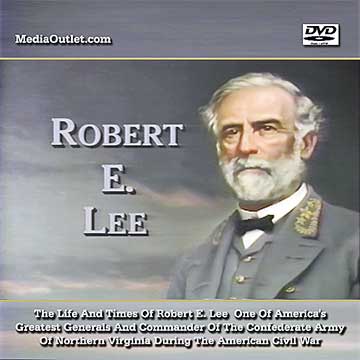
April 20, 1861: The American Civil War
(The Civil War, The War Between The States): -- Robert E. Lee
resigns his commission in the United States Army in order to
command the forces of the state of Virginia. Unlike many
Southerners who expected a glorious war, Lee correctly predicted
it as protracted and devastating. He privately opposed the new
Confederate States of America in letters in early 1861, denouncing
secession as "nothing but revolution" and an
unconstitutional betrayal of the efforts of the Founding Fathers.
Despite opposing secession, Lee said in January that "we can
with a clear conscience separate" if all peaceful means
failed. He agreed with secessionists in most areas, such as
dislike of Northern anti-slavery criticisms and prevention of
expanding slavery to new territories, and fear of its larger
population. Lee supported the Crittenden Compromise, which would
have constitutionally protected slavery. Lee's objection to
secession was ultimately outweighed by a sense of personal honor,
reservations about the legitimacy of a strife-ridden "Union
that can only be maintained by swords and bayonets", and duty
to defend his native Virginia if attacked. He was asked while
leaving Texas by a lieutenant if he intended to fight for the
Confederacy or the Union, to which Lee replied, "I shall
never bear arms against the Union, but it may be necessary for me
to carry a musket in the defense of my native state, Virginia, in
which case I shall not prove recreant to my duty." On Sale @
15% Off Discount Till Midnight PT!
https://store.earthstation1.com/robert-e-lee-documentaries-dvd.html
Today's
EarthStation1.com 15% Off Commemorative Memorial Title: The Old
Time Radio Drama MP3 MegaSet DVD, Audio Download, USB Stick
Today, April 20, 2026
April 20, 1862: Abiogenesis (The Origins
Of Life, Biogenesis): Spontaneous Generation Vs. Abiogenesis: --
Louis Pasteur completes an experiment begun in 1859 that falsifies
the theory of spontaneous generation, which held that living
creatures could arise from nonliving matter, and that such
processes were commonplace and regular. Pasteur experiment showed
that a boiled nutrient broth did not give rise spontaneously to
new life, but that if direct access to air was permitted, the
broth decomposed, implying that small organisms (in modern terms,
microbial spores) had fallen in and started to grow in the broth.
He boiled a meat broth in a swan neck flask; the bend in the neck
of the flask prevented falling particles from reaching the broth,
while still allowing the free flow of air. The flask remained free
of growth for an extended period. When the flask was turned so
that particles could fall down the bends, the broth quickly became
clouded. However, minority objections were persistent and not
always unreasonable, given that the experimental difficulties were
far more challenging than the popular accounts suggest. The
investigations of the Irish physician John Tyndall, a
correspondent of Pasteur and an admirer of his work, were decisive
in disproving spontaneous generation. All the same, Tyndall
encountered difficulties in dealing with microbial spores, which
were not well understood in his day. Like Pasteur, he boiled his
cultures to sterilize them, and some types of bacterial spores can
survive boiling. The autoclave, which eventually came into
universal application in medical practice and microbiology to
sterilise equipment, was introduced after these experiments. In
1862, the French Academy of Sciences paid special attention to the
issue, establishing a prize "to him who by well-conducted
experiments throws new light on the question of the so-called
spontaneous generation" and appointed a commission to judge
the winner. Pasteur and others used the term biogenesis as the
opposite of spontaneous generation, to mean that life was
generated only from other life. Pasteur's claim followed the
German physician Rudolf Virchow's doctrine Omnis cellula e cellula
("all cells from cells"), itself derived from the work
of Robert Remak, a Polish physiologist who discovered that the
origin of cells was by the division of pre-existing cells.
Rejection of spontaneous generation is no longer controversial
among biologists. On Sale @ 15% Off Discount Till Midnight PT!
https://store.earthstation1.com/the-old-time-radio-drama-mp3-dvd-megase3.html
Today's
EarthStation1.com 15% Off Commemorative Memorial Title: Hate On
Trial: SPLC Vs WAR Trial + Skinhead USA MP4 Download DVD Set
Today, April 20, 2026
April 20, 1871: The Reconstruction Era
(Reconstruction): The Ku Klux Klan Act (The Enforcement Act Of
1871, The Third Enforcement Act, The Third Ku Klux Klan Act, The
Civil Rights Act of 1871, The Force Act of 1871): -- President
Ulysses S. Grant signs into law the Third Enforcement Act, an Act
of the United States Congress which empowered the President to
suspend the writ of habeas corpus to combat the Ku Klux Klan (KKK)
and other white supremacy organizations. Passed by the 42nd United
States Congress, it passed the House on April 7, 1871 (118 yea, 91
nay) and the Senate on April 14, 1871 (45 yea, 19 nay). The act
was the last of three Enforcement Acts passed by the United States
Congress from 1870 to 1871 during the Reconstruction Era to combat
attacks upon the suffrage rights of African Americans: the right
to vote, to hold office, to serve on juries, and receive equal
protection of laws. The statute has been subject to only minor
changes since then, but has been the subject of voluminous
interpretation by courts. This legislation was asked for by
President Grant and passed within one month of when he sent the
request to Congress. Grant's request was a result of the reports
he was receiving of widespread racial threats in the Deep South,
particularly in South Carolina. He felt that he needed to have his
authority broadened before he could effectively intervene. After
the act's passage, the president had the power for the first time
to both suppress state disorders on his own initiative and to
suspend the writ of habeas corpus. Grant did not hesitate to use
this authority on numerous occasions during his presidency, and as
a result the KKK was completely dismantled (ending the "first
Klan" era) and did not resurface in any meaningful way until
the beginning of the 20th century. Several of the act's provisions
still exist today as codified statutes. The most important of
these is 42 U.S.C. Sub. 1983: Civil action for deprivation of
rights. It is the most widely used civil rights enforcement
statute, allowing people to sue in civil court over civil rights
violations. On Sale @ 15% Off Discount Till Midnight PT!
https://store.earthstation1.com/hate-on-trial-splc-vs-war-racism-on-trial-mp4-video-download-dvd-se4.html
Today's
EarthStation1.com 15% Off Commemorative Memorial Title: The Adolf
Hitler Documentaries Collection DVD, Download, USB Drive
Today, April 20, 2026
April 20, 1889: #BOTD: Adolf Hitler,
German politician who was the leader of the Nazi Party, Chancellor
of Germany from 1933 to 1945 and Fuehrer ("Leader") of
Nazi Germany from 1934 to 1945 (d. April 30 1945?) is #born in
Braunau am Inn, Austria. As dictator of Nazi Germany, Hitler
initiated World War II in Europe with the Invasion Of Poland in
September 1939, and was central to the Holocaust. Hitler was
raised near Linz, Austria. He moved to Germany in 1913 and was
decorated during his service in the German Army in World War I. In
1919, he joined the German Workers' Party (DAP), the precursor of
the NSDAP, and was appointed leader of the NSDAP in 1921. In 1923,
he attempted to seize power in a failed coup in Munich and was
imprisoned. While in jail he dictated the first volume of his
autobiography and political manifesto Mein Kampf ("My
Struggle"). After his release from prison in 1924, Hitler
gained popular support by attacking the Treaty Of Versailles and
promoting Pan-Germanism, anti-semitism and anti-communism with
charismatic oratory and Nazi propaganda. He frequently denounced
international capitalism and communism as being part of a Jewish
conspiracy. By 1933, the Nazi Party was the largest elected party
in the German Reichstag, but did not have a majority, and no party
was able to form a majority parliamentary coalition in support of
a candidate for chancellor. This led to former chancellor Franz
Von Papen and other conservative leaders persuading President Paul
Von Hindenburg to appoint Hitler as Chancellor on 30 January 1933.
Shortly after, the Reichstag passed the Enabling Act of 1933,
which began the process of transforming the Weimar Republic into
Nazi Germany, a one-party dictatorship based on the totalitarian
and autocratic ideology of National Socialism. Hitler aimed to
eliminate Jews from Germany and establish a New Order to counter
what he saw as the injustice of the post-World War I international
order dominated by Britain and France. His first six years in
power resulted in rapid economic recovery from the Great
Depression, the abrogation of restrictions imposed on Germany
after World War I and the annexation of territories that were home
to millions of ethnic Germans which gave him significant popular
support. Hitler sought Lebensraum ("living space") for
the German people in Eastern Europe and his aggressive foreign
policy is considered to be the primary cause of the outbreak of
World War II in Europe. He directed large-scale rearmament and on
1 September 1939 invaded Poland, resulting in Britain and France
declaring war on Germany. In June 1941, Hitler ordered an invasion
of the Soviet Union. By the end of 1941, German forces and the
European Axis powers occupied most of Europe and North Africa. In
December 1941, he formally declared war on the United States,
bringing America directly into the conflict. Failure to defeat the
Soviets and the entry of the United States into the war forced
Germany onto the defensive and it suffered a series of escalating
defeats. In the final days of the war during the Battle of Berlin
in 1945, he married his long-time lover Eva Braun. Less than two
days later on April 30, 1945, the two reputedly committed suicide
to avoid capture by the Soviet Red Army and their corpses were
burned; the controversies regarding the veracities of this account
cotinue to this day, and the final disposition of their corpses
remain unresolved. Under Hitler's leadership and racially
motivated ideology, the Nazi regime was responsible for the
genocide of at least 5.5 million Jews and as many more other
victims whom he and his followers deemed Untermenschen
(sub-humans) or socially undesirable. Hitler and the Nazi regime
were also responsible for the killing of an estimated 19.3 million
civilians and prisoners of war. In addition, 29 million soldiers
and civilians died as a result of military action in the European
theatre. The number of civilians killed during the Second World
War was unprecedented in warfare and the casualties constituted
the deadliest conflict in human history. On Sale @ 15% Off
Discount Till Midnight PT!
https://store.earthstation1.com/adolf-hitler-documentaries-world-war-ii-3rd-reich-dual-layer-dv3.html
Today's
EarthStation1.com 15% Off Commemorative Memorial Title:
Montparnasse Revisited: The Genius That Was Paris DVD, MP4, USB
Drive
Today, April 20, 2026
April 20, 1893: #BOTD: #HBD! Joan Miro,
Spanish painter, sculptor and ceramicist (d. December 25, 1983) is
#born Joan Miro i Ferra in Barcelona, Spain. Earning international
acclaim, his work has been interpreted as Surrealism but with a
personal style, sometimes also veering into Fauvism and
Expressionism. He was notable for his interest in the unconscious
or the subconscious mind, reflected in his re-creation of the
childlike. His difficult-to-classify works also had a
manifestation of Catalan pride. In numerous interviews dating from
the 1930s onwards, Miro expressed contempt for conventional
painting methods as a way of supporting bourgeois society, and
declared an "assassination of painting" in favour of
upsetting the visual elements of established painting. A museum
dedicated to his work, the Fundacio Joan Miro, was established in
his native city of Barcelona in 1975, and another, the Fundacio
Pilar i Joan Miro, was established in his adoptive city of Palma
in 1981. Joan Mirodies died from heart failure in his home in
Palma (Majorca), Spain on at age 90. He was later interred in the
Montjuic Cemetery in Barcelona. Miro's 1925 painting "Calculation"
is featured on the cover of the Dave Brubeck album "Time
Further Out: Reflections On Miro". In his liner notes,
Brubeck says the album is a "jazz interpretation" of the
painting, and was conceived as a "blues suite". On Sale
@ 15% Off Discount Till Midnight PT!
https://store.earthstation1.com/montparnasse-revisted-the-genius-that-was-paris-3-dvd3.html
Today's
EarthStation1.com 15% Off Commemorative Memorial Title: The
Freshman (1925) Sound Edition + His Royal Slyness DVD, MP4, USB
Today, April 20, 2026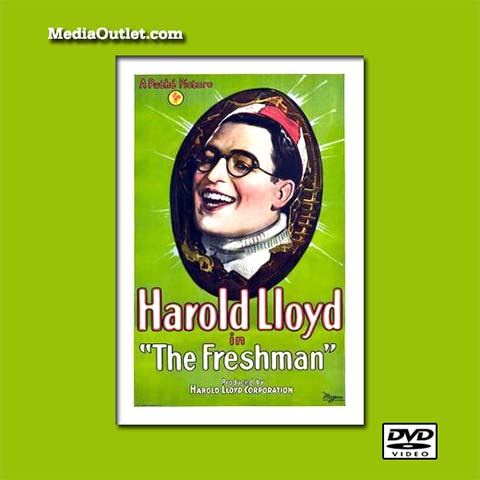
April 20, 1893: #BOTD: #HBD! Harold
Lloyd, American actor, comedian, film director, film producer,
screenwriter, stunt performer and Freemason, best known for his
silent comedy films and who ranks alongside Charlie Chaplin and
Buster Keaton as one of the most popular and influential film
comedians of the silent film era (d. March 8, 1971) is #born
Harold Clayton Lloyd in Burchard, Nebraska. Harold Clayton Lloyd
Sr. made nearly 200 comedy films, both silent and "talkies",
between 1914 and 1947. He is best known for his bespectacled
"Glasses" character, a resourceful, success-seeking
go-getter who was perfectly in tune with 1920s-era United States.
His films frequently contained "thrill sequences" of
extended chase scenes and daredevil physical feats, for which he
is best remembered today. Lloyd hanging from the hands of a clock
high above the street (in reality a trick shot) in Safety Last!
(1923) is one of the most enduring images in all of cinema. Lloyd
did many dangerous stunts himself, despite having injured himself
in August 1919 while doing publicity pictures for the Roach
studio, when a bomb mistaken as a prop resulted in the loss of the
thumb and index finger of his right hand (the injury was disguised
on future films with the use of a special prosthetic glove, though
the glove often did not go unnoticed). Although Lloyd's individual
films were not as commercially successful as Chaplin's on average,
he was far more prolific (releasing 12 feature films in the 1920s
while Chaplin released just four), and made more money overall
(15.7M USD to Chaplin's 10.5M USD). Harold Lloyd died at age 77
from prostate cancer at his Greenacres home in Beverly Hills,
California. He is interred in a crypt in the Great Mausoleum at
Forest Lawn Memorial Park Cemetery in Glendale, California. His
former co-star Bebe Daniels died eight days after him, and his son
Harold Lloyd Jr. died three months after him. On Sale @ 15% Off
Discount Till Midnight PT!
https://store.earthstation1.com/the-freshman-1925-dvd-special-edition-plus-his-royal-sly1925.html
Today's
EarthStation1.com 15% Off Commemorative Memorial Title:
Spanish-American War & Cuban War Of Independence DVD,
Download, USB
Today, April 20, 2026
April 20, 1898: The Decolonization Of The
Americas: The Cuban War Of Independence (The Necessary War): The
Spanish-American War: -- President William McKinley signs a joint
Congressional resolution demanding Spanish withdrawal and
authorizing the President to use military force to help Cuba gain
independence. The following day, The United States Navy begins a
blockade of Cuban ports. When the U.S. Congress issues a
declaration of war on April 25, it declared that a state of war
had existed from the date of the blockade, though the de facto
Spanish-American War begins on April 20. The Spanish-American War
was fought between the United States and Spain in 1898.
Hostilities began in the aftermath of the internal explosion of
the USS Maine in Havana Harbor in Cuba, leading to U.S.
intervention in the Cuban War of Independence. American
acquisition of Spain's Pacific possessions led to its involvement
in the Philippine Revolution and ultimately in the
Philippine-American War. The main issue was Cuban independence.
Revolts had been occurring for some years in Cuba against Spanish
rule. The U.S. later backed these revolts upon entering the
Spanish-American War. There had been war scares before, as in the
Virginius Affair in 1873, but in the late 1890s, U.S. public
opinion was agitated by anti-Spanish propaganda led by newspaper
publishers such as Joseph Pulitzer and William Randolph Hearst
which used yellow journalism to call for war. The business
community across the United States had just recovered from a deep
depression and feared that a war would reverse the gains. It
lobbied vigorously against going to war. The United States Navy
armoured cruiser Maine had mysteriously sunk in Havana Harbor;
political pressures from the Democratic Party pushed the
administration of Republican President William McKinley into a war
that he had wished to avoid. President McKinley signed a joint
Congressional resolution demanding Spanish withdrawal and
authorizing the President to use military force to help Cuba gain
independence on April 20, 1898. In response, Spain severed
diplomatic relations with the United States on April 21. On the
same day, the U.S. Navy began a blockade of Cuba. On April 23,
Spain stated that it would declare war if the U.S. forces invaded
its territory. On April 25, Congress declared that a state of war
between the U.S. and Spain had de facto existed since April 21,
the day the blockade of Cuba had begun. The United States sent an
ultimatum to Spain demanding that it surrender control of Cuba,
but due to Spain not replying soon enough, the United States
assumed Spain had ignored the ultimatum and continued to occupy
Cuba. The ten-week war was fought in both the Caribbean and the
Pacific. As the American agitators for war well knew, U.S. naval
power proved decisive, allowing expeditionary forces to disembark
in Cuba against a Spanish garrison already facing nationwide Cuban
insurgent attacks and further wasted by yellow fever. American,
Cuban, and Philippine forces obtained the surrender of Santiago de
Cuba and Manila despite the good performance of some Spanish
infantry units and fierce fighting for positions such as San Juan
Hill. Madrid sued for peace after two obsolete Spanish squadrons
sunk in Santiago de Cuba and Manila Bay and a third, more modern
fleet was recalled home to protect the Spanish coasts. The result
was the 1898 Treaty Of Paris, negotiated on terms favorable to the
U.S. which allowed it temporary control of Cuba and ceded
ownership of Puerto Rico, Guam and the Philippine islands. The
cession of the Philippines involved payment of 20M USD
(588,320,000 USD today) to Spain by the U.S. to cover
infrastructure owned by Spain. The defeat and loss of the last
remnants of the Spanish Empire was a profound shock to Spain's
national psyche and provoked a thorough philosophical and artistic
revaluation of Spanish society known as the Generation of '98. The
United States gained several island possessions spanning the globe
and a rancorous new debate over the wisdom of expansionism. It was
one of only five US wars (against a total of eleven sovereign
states) to have been formally declared by the U.S. Congress. On
Sale @ 15% Off Discount Till Midnight PT!
https://store.earthstation1.com/spanishamerican-war-films-dvd.html
Today's
EarthStation1.com 15% Off Commemorative Memorial Title: Rhythm And
Blues Revue (1955) DVD, MP4 Video Download, USB Flash Drive
Today, April 20, 2026
April 20, 1908: #BOTD: #HBD! Lionel
Hampton, pioneer African American jazz vibraphonist, pianist,
percussionist, bandleader, composer and actor, member of The Benny
Goodman Quartet which some consider the best musical combo in
history, considered along with Louis Jorden to be one of the
pioneers of rock and roll years before it was so named, considered
one of the greatest jazz musicians in history (d. August 31, 2002)
is #born Lionel Leo Hampton in Louisville, Kentucky. Lionel
Hampton worked with jazz musicians from Teddy Wilson, Benny
Goodman, and Buddy Rich to Charlie Parker, Charles Mingus, and
Quincy Jones. He appears in such movies as A Song Is Born, The
Benny Goodman Story and Mister Rock and Roll. In 1992, he was
inducted into the Alabama Jazz Hall of Fame, and was awarded the
National Medal of Arts in 1996. Lionel Hampton died of congestive
heart failure at Mount Sinai Hospital, New York City, aged 94. He
is interred at the Woodlawn Cemetery, Bronx, New York. His funeral
was held on September 7, 2002, and featured a performance by
Wynton Marsalis and David Ostwald's Gully Low Jazz Band at
Riverside Church in Manhattan; the procession began at The Cotton
Club in Harlem. Speakers at his funeral included U.S.
representatives Charles Rangel and John Conyers and former
President George H. W. Bush. On Sale @ 15% Off Discount Till
Midnight PT!
https://store.earthstation1.com/rhythm-and-blues-revue-dvd-1955-apollo-theater-tv-1955.html
Today's
EarthStation1.com 15% Off Commemorative Memorial Title: America:
The Second Century Documentary Series DVD, Download, USB
Today, April 20, 2026
April 20, 1914: Labor Union Disputes
(Trade Union Disputes): The Coal Wars: The Colorado Coalfield War:
The Ludlow Massacre: -- A tent colony of roughly 1,200 striking
coal miners of the United Mine Workers of America and their
families in Ludlow, Colorado are attacked by soldiers from the
Colorado National Guard and private anti-striker militia guards
employed by Colorado Fuel and Iron Company (C F & I).
Approximately 21 people, including miners' wives and children,
were killed; 5 men and a boy were killed by machine gun fire,
while 11 children and 2 women burned to death as the miners' tent
colony was destroyed. John D. Rockefeller, Jr., a part-owner of C
F & I, who had recently appeared before a United States
congressional hearing on the strikes, was widely excoriated for
having orchestrated the massacre. The massacre was the seminal
event of the 1913-1914 Colorado Coalfield War, which began when
the United Mine Workers of America, who were seeking recognition
of their union, launched a general strike against poor labor
conditions in C F & I's southern Colorado coal mines. The
strike was organized by the miners against coal mining companies
in Colorado. Miners working for the Rocky Mountain Fuel Company
and Victor-American Fuel Company. Ludlow was the deadliest single
incident during the Colorado Coalfield War and spurred a ten-day
period of heightened violence throughout Colorado. In retaliation
for the massacre at Ludlow, bands of armed miners attacked dozens
of anti-union establishments, destroying property and engaging in
several skirmishes with the Colorado National Guard along a
225-mile (362 km) front from Trinidad to Louisville. From the
strike's beginning in September 1913 to intervention by federal
soldiers under President Woodrow Wilson's orders on April 29,
1914, an estimated 69 to 199 people were killed during the strike.
Historian Thomas G. Andrews has called it the "deadliest
strike in the history of the United States." The Ludlow
Massacre was a watershed moment in American labor relations.
Socialist historian Howard Zinn described it as "the
culminating act of perhaps the most violent struggle between
corporate power and laboring men in American history".
Congress responded to public outrage by directing the House
Committee on Mines and Mining to investigate the events. Its
report, published in 1915, was influential in promoting child
labor laws and an eight-hour work day. The Ludlow townsite and the
adjacent location of the tent colony, 18 miles (29 km) northwest
of Trinidad, Colorado, is now a ghost town. The massacre site is
owned by the United Mine Workers of America, which erected a
granite monument in memory of those who died that day. The Ludlow
tent colony site was designated a National Historic Landmark on
January 16, 2009, and dedicated on June 28, 2009. Subsequent
investigations immediately following the massacre and from modern
archeological efforts largely support some of the strikers'
accounts of the event. On Sale @ 15% Off Discount Till Midnight
PT!
https://store.earthstation1.com/america-the-second-century-us-2nd-100-years-history-621006.html
Today's
EarthStation1.com 15% Off Commemorative Memorial Title: Von
Richthofen And Brown 1971 Red Baron Movie DVD, Download, USB
Today, April 20, 2026
April 20, 1918: The European Civil War:
World War I: The First European War (The European Theater Of World
War I): The Western Front Of World War I: Air Warfare Of World War
I: Manfred Von Richthofen (The Red Baron): -- Manfred von
Richthofen, (in)famous as "The Red Baron", German
captain and fighter pilot with the German Air Force during World
War I considered the ace-of-aces of the war with 80 officially
credited air combat victories (May 2, 1892 - April 21, 1918),
shoots down his 79th and 80th victims, his final victories before
his death the following day. He was born Manfred Albrecht Freiherr
von Richthofen in Kleinburg, near Breslau, Lower Silesia (now part
of the city of Wroclaw, Poland) into a prominent Prussian
aristocratic family. Originally a cavalryman, Richthofen
transferred to the Air Service in 1915, becoming one of the first
members of fighter squadron Jagdstaffel 2 in 1916. He quickly
distinguished himself as a fighter pilot, and during 1917 became
leader of Jasta 11 and then the larger fighter wing unit
Jagdgeschwader 1, better known as "The Flying Circus" or
"Richthofen's Circus" because of the bright colours of
its aircraft, and perhaps also because of the way the unit was
transferred from one area of allied air activity to another -
moving like a travelling circus, and frequently setting up in
tents on improvised airfields. By 1918, Richthofen was regarded as
a national hero in Germany, and respected by his enemies. He
remains one of the most widely known fighter pilots of all time,
and has been the subject of many books, films and other media. On
April 21, 1918: he was shot down and killed just after 11:00 AM
over Vaux-sur-Somme while flying over Morlancourt Ridge near the
Somme River. There has been considerable discussion and debate
regarding aspects of his career, especially the circumstances of
his death. Having crashed in Allied territory, Officers of No. 3
Squadron of the Australian Flying Corps (AFC) of the Royal
Australian Air Force (RAAF) were pallbearers at his funeral, and
other ranks from the squadron acted as a guard of honour during
the Red Baron's funeral on 22 April 1918. In the early 1920s the
French authorities created a military cemetery at Fricourt, in
which a large number of German war dead, including Richthofen,
were reinterred. In 1925 von Richthofen's youngest brother, Bolko,
recovered the body from Fricourt and took it to Germany. During
the Cold War, the Invalidenfriedhof was on the boundary of the
Soviet zone in Berlin, and the tombstone became damaged by bullets
fired at attempted escapees from East Germany. In 1975 the body
was moved to a Richthofen family grave plot at the Sudfriedhof in
Wiesbaden. On Sale @ 15% Off Discount Till Midnight PT!
https://store.earthstation1.com/von-richthofen-and-brown-dvd-red-baron-wwi.html
Today's
EarthStation1.com 15% Off Commemorative Memorial Title: Combat At
Sea Documentary Series + 2 Bonuses MP4 Video Download DVDs
Today, April 20, 2026
April 20, 1918: #BOTD: #HBD! Edward L.
Beach Jr., nicknamed "Ned", highly decorated United
States Navy submarine officer, commander of the first submerged
circumnavigation of the globe, and author of the best-selling
novel Run Silent, Run Deep, which was made into the 1958 movie by
the same name (d. December 1, 2002) is #born in New York City.
During World War II, he participated in the Battle of Midway and
12 combat patrols, earning 10 decorations for gallantry, including
the Navy Cross. After the war, he served as the naval aide to the
President of the United States, Dwight D. Eisenhower. On February
16, 1960, Captain Beach, in command of the U.S. Navy's
nuclear-powered radar picket submarine USS Triton (SSRN-586),
began Operation Sandblast, the code name for the first submerged
circumnavigation of the world, when he set sail from New London,
Connecticut to begin this first submerged circumnavigation of the
globe on February 24. Triton's overall navigational track during
Operation Sandblast generally followed that of the Spanish
expedition that achieved the first circumnavigation of the world,
started under the command of Portuguese explorer Ferdinand
Magellan and completed by Spanish explorer Juan Sebastian Elcano
from 1519 to 1522. The New York Times described Triton's submerged
circumnavigation of the Earth as "a triumph of human prowess
and engineering skill, a feat which the United States Navy can
rank as one of its bright victories in man's ultimate conquest of
the seas." The circumnavigation took place between February
24 and April 25, 1960, covering 26,723 nautical miles (49,491 km;
30,752 mi) over 60 days and 21 hours. The route began and ended at
the St. Peter and Paul Rocks (The Saint Peter and Saint Paul
Archipelago) in the middle of the Atlantic Ocean near the Equator.
During the voyage, Triton crossed the Equator four times while
maintaining an average speed of 18 knots (33 km/h; 21 mph). The
initial impetus for Operation Sandblast was to increase American
technological and scientific prestige before the May 1960 Paris
Summit between President Dwight D. Eisenhower and Soviet Premier
Nikita Khrushchev. It also provided a high-profile public
demonstration of the capability of U.S. Navy nuclear-powered
submarines to carry out long-range submerged operations
independent of external support and undetected by hostile forces,
presaging the initial deployment of the Navy's Polaris ballistic
missile submarines later in 1960. Finally, Operation Sandblast
gathered extensive oceanographic, hydrographic, gravimetric,
geophysical, and psychological data during Triton's
circumnavigation. Official celebrations were cancelled for
Operation Sandblast following the diplomatic furor arising from
the 1960 U-2 incident in which a U-2 spy plane was shot down over
the Soviet Union in early May. However, Triton did receive the
Presidential Unit Citation with a special clasp in the form of a
golden replica of the globe in recognition of the successful
completion of its mission, and Captain Beach received the Legion
of Merit for his role as Triton's commanding officer. In 1961,
Beach received the Magellanic Premium from the American
Philosophical Society, the United States' oldest and most
prestigious scientific award in "recognition of his
navigation of the U.S. submarine Triton around the globe." On
Sale @ 15% Off Discount Till Midnight PT!
https://store.earthstation1.com/combat-at-sea-dvd-set-all-12-naval-warfare-tv-shows-6-di126.html
Today's
EarthStation1.com 15% Off Commemorative Memorial Title: Machito: A
Latin Jazz Legacy DVD, MP4 Video Download, USB Flash Drive
Today, April 20, 2026
April 20, 1923: #BOTD: #HBD! Tito Puente,
American drummer and producer (d. June 1, 2000) is #born Ernest
Anthony Puente Jr. at Harlem Hospital Center, Manhattan, New York
City. Tito Puente was an American musician, songwriter and record
producer. The son of Ernest and Ercilia Puente, native Puerto
Ricans living in New York City's Spanish Harlem, Puente is often
credited as "The Musical Pope", "El Rey de los
Timbales" (The King of the Timbales) and "The King of
Latin Music". He is best known for dance-oriented mambo and
Latin jazz compositions that endured over a 50-year career. He and
his music appear in many films such as The Mambo Kings and
Fernando Trueba's Calle 54. He guest-starred on several television
shows, including Sesame Street and The Simpsons two-part episode
"Who Shot Mr. Burns?". His famous song is "Oye Como
Va". Tito Puente died at 2:27am in New York City of
complications involving heart valve surgery, aged 77. He is buried
at Saint Anthony's Catholic Cemetery in Nanuet, New York. On Sale
@ 15% Off Discount Till Midnight PT!
https://store.earthstation1.com/machito-a-latin-jazz-legacy-dvd.html
Today's
EarthStation1.com 15% Off Commemorative Memorial Title: Remember
Pearl Harbor 50th Anniversary Special MP4 Video Download DVD
Today, April 20, 2026
April 20, 1937: #BOTD: #HBD! George
Takei, Japanese American actor, director, author, and activist, is
#born Hosato Takei in Los Angeles, California. George Takei is
best known for his role as Hikaru Sulu, helmsman of the USS
Enterprise in the television series Star Trek. He also portrayed
the character in six Star Trek feature films and one episode of
Star Trek: Voyager. As of April 2018, his Facebook page has over
10 million followers since he joined in 2011, and the account
frequently shares photos with original humorous commentary. Takei
is a proponent of LGBT rights and is active in state and local
politics. He has won several awards and accolades in his work on
human rights and Japan-United States relations, including his work
with the Japanese American National Museum. Takei's work on the
broadway show, Allegiance, as well as his own internment in a
US-run concentration camp during World War II has given him a
platform to speak out against government rhetoric about immigrants
and immigration policies. On Sale @ 15% Off Discount Till Midnight
PT!
https://store.earthstation1.com/remember-pearl-harbor-50th-anniversary-special-mp4-video-download-dvd.html
Today's
EarthStation1.com 15% Off Commemorative Memorial Title: Hitler:
The Final Chapter The Fate Of Adolf Hitler's Body DVD MP4 USB
Today, April 20, 2026
April 20, 1945: The European Civil War:
World War II: The Second European War (The European Theater Of
World War II): The Eastern Front Of World War II: The Great
Patriotic War (The German-Soviet War): The Battle Of Berlin (The
Berlin Strategic Offensive Operation, The Fall Of Berlin): The
Fuhrerbunker (The Fuehrerbunker): -- Adolf Hitler makes his last
trip to the surface to award Iron Crosses to boy soldiers of the
Hitler Youth.The Fuehrerbunker was an air raid shelter located
near the Reich Chancellery in Berlin, Germany. It was part of a
subterranean bunker complex constructed in two phases in 1936 and
1944. It was the last of the Fuehrer Headquarters used by Adolf
Hitler during World War II. Hitler took up residence in the
Fuhrerbunker on 16 January 1945, and it became the centre of the
Nazi regime until the last week of World War II in Europe. Hitler
married Eva Braun there during the last week of April 1945,
shortly before they committed suicide. After the war, both the old
and new Chancellery buildings were levelled by the Soviets. The
underground complex remained largely undisturbed until 1988-89,
despite some attempts at demolition. The excavated sections of the
old bunker complex were mostly destroyed during reconstruction of
that area of Berlin. The site remained unmarked until 2006, when a
small plaque was installed with a schematic diagram. Some
corridors of the bunker still exist but are sealed off from the
public. On Sale @ 15% Off Discount Till Midnight PT!
https://store.earthstation1.com/hitler-the-final-chapter-the-fate-of-adolf-hitler39s-body-dvd-mp4-394.html
Today's
EarthStation1.com 15% Off Commemorative Memorial Title: China In
Revolution 1911-1949 TV Series DVD, Download, USB Flash Drive
Today, April 20, 2026
April 20, 1949: China: The History Of
China: The Century Of Humiliation (The Hundred Years Of National
Humiliation): The Chinese Civil War: The History Of The Republic
Of China (1912-1949): The Yangtze River Crossing Campaign
(Chinese: Du Jiang Zhanyi): -- The Yangtze River Crossing Campaign
begins, beginning the end of Chinese Nationalist rule of China. By
the follow day, The People's Liberation Army (PLA) of the Chinese
Communist Party (CCP), under the joint command of Liu Bocheng,
Chen Yi and future leader of China Deng Xiaoping, would capture
Nanjing, the capital of the Nationalist government of the
Kuomintang (KMT, also known as Guomintang (GMD)), whose defense
was led by Tang Enbo and Bai Chongxiin, which marked the end of
GMD rule in China, since Nanjing was the capital of the
Nationalist government. The Fall Of Nanjing forced the GMD
government to retreat, who took with them as many cultural
artifacts as they could carry, suggesting that the war was over;
when the city center of Shanghai fell to the Communists on May 27,
and the rest of the Zhejiang fell to the communist Chinese on June
2, it marked both the end of the Yangtze River Crossing Campaign
and the end of Chinese Civil War. On Sale @ 15% Off Discount Till
Midnight PT!
https://store.earthstation1.com/china-in-revolution-19111949-dvd-2-part-tv-documenta191119492.html
Today's
EarthStation1.com 15% Off Commemorative Memorial Title: Smokey
Robinson: The Quiet Legend DVD, MP4 Video Download, USB Drive
Today, April 20, 2026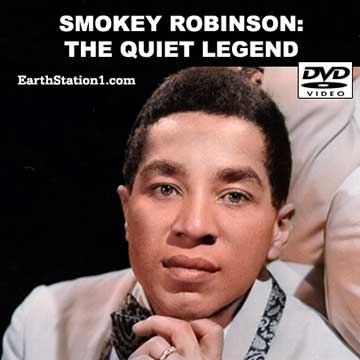
April 20, 1951: #BOTD: #HBD! Luther
Vandross, African American singer-songwriter and producer (d. July
1, 2005) is #born Luther Ronzoni Vandross, Jr. at Bellevue
Hospital, in the Kips Bay neighborhood of Manhattan, New York
City. Throughout his career, Luther Ronzoni Vandross Jr. was an
in-demand background vocalist for several different artists
including Todd Rundgren, Judy Collins, Chaka Khan, Bette Midler,
Diana Ross, David Bowie, Ben E. King, and Donna Summer. He later
became a lead singer of the group Change, which released its
gold-certified debut album, The Glow of Love, in 1980 on
Warner/RFC Records. After Vandross left the group, he was signed
to Epic Records as a solo artist and released his debut solo
album, Never Too Much, in 1981. His hit songs include "Never
Too Much", "Here and Now", "Any Love",
"Power of Love/Love Power", "I Can Make It Better"
and "For You to Love". Many of his songs were covers of
original music by other artists such as "If This World Were
Mine" (duet with Cheryl Lynn), "Since I Lost My Baby",
"Superstar", "I (Who Have Nothing)" and
"Always and Forever". Duets such as "The Closer I
Get to You" with Beyonce, "Endless Love" with
Mariah Carey and "The Best Things in Life Are Free" with
Janet Jackson were all hit songs in his career. During his career,
Vandross sold over 35 million records worldwide, and received
eight Grammy Awards including Best Male R & B Vocal
Performance four different times. He won a total of four Grammy
Awards in 2004 including the Grammy Award for Song of the Year for
a song recorded not long before his death, "Dance with My
Father". Luther Vandross died at the JFK Medical Center in
Edison, New Jersey of a heart attack at age 54. He is buried at
George Washington Memorial Park in Paramus, New Jersey. On Sale @
15% Off Discount Till Midnight PT!
https://store.earthstation1.com/smokey-robinson-the-quiet-legend-dvd-mp4-download-usb-driv4.html
Today's
EarthStation1.com 15% Off Commemorative Memorial Title: The Bay Of
Pigs Invasion DVD, MP4 Video Download, USB Flash Drive
Today, April 20, 2026
April 20, 1961: Cuba: The History Of
Cuba: The Aftermath Of World War II: The Cold War: The Cuban Cold
War: The Cuban Revolution: The Consolidation Of The Cuban
Revolution (Cuba Under Fidel Castro): The Bay Of Pigs Invasion
(Spanish: Invasion De Bahia De Cochinos, Invasion De Playa Giron,
Batalla De Playa Giron): The Bay Of Pigs Invasion D+3: -- The
US-backed Bay Of Pigs Invasion by Cuban exiles against Cuba
ingloriously fails. The Bay Of Pigs Invasion was a military
invasion of Cuba undertaken by the CIA-sponsored paramilitary
group Brigade 2506 on 17 April 1961. A counter-revolutionary
military group - made up mostly of Cuban exiles who traveled to
the United States after Castro's takeover, but also some US
military personnel - trained and funded by the CIA, Brigade 2506
fronted the armed wing of the Democratic Revolutionary Front (DRF)
and intended to overthrow the increasingly communist government of
Fidel Castro. Launched from Guatemala and Nicaragua, the invading
force was defeated within three days by the Cuban Revolutionary
Armed Forces, under the direct command of Castro. The coup of 1952
led by General Fulgencio Batista, an ally of the United States,
against President Carlos Prio, forced Prio into exile to Miami,
Florida. Prio's exile was the reason for the 26th July Movement
led by Castro. Nevertheless, the US became increasingly
dissatisfied with the rule of Batista, and the CIA provided
support to Castro and his movement. When the movement succeeded
after the Cuban Revolution of 31 December 1958, Castro severed the
country's existing strong links with the US and nationalized
American economic assets (banks, oil refineries, sugar and coffee
plantations, along with other American owned businesses). After
the Cuban Revolution of 1959, Castro forged strong economic links
with the Soviet Union, with whom the United States was engaged in
the Cold War. US President Dwight D. Eisenhower was very concerned
at the direction Castro's government was taking, and in March
1960, during the last year of Eisenhower's administration, he
allocated 13.1M USD to the CIA to plan Castro's overthrow, even
though the plan would ultimately be prepared for execution during
the beginning of the next presidential administration. The CIA
proceeded to organize the operation with the aid of various Cuban
counter-revolutionary forces, training Brigade 2506 in Guatemala.
Eisenhower's successor, John F. Kennedy, approved the final
invasion plan on 4 April 1961, though he protested during and
after the invasion that the CIA had misrepresented much regarding
the operation, resulting in a number of decisions by the
president, particularly that of not continuing to provide American
air cover, that ultimately resulted in the failure of the
invasion. Over 1,400 paramilitaries, divided into five infantry
battalions and one paratrooper battalion, assembled in Guatemala
before setting out for Cuba by boat on 13 April 1961. Two days
later, on 15 April, eight CIA-supplied B-26 bombers attacked Cuban
airfields and then returned to the US. On the night of 16 April,
the main invasion landed at a beach named Playa Giron (Giron
Beach) in the Bay Of Pigs. It initially overwhelmed a local
revolutionary militia. The Cuban Army's counter-offensive was led
by Jose Ramon Fernandez until Castro decided to take personal
control of the operation. As the operation proved not simply to be
that of Cuban exiles attempting to liberate their country, but
rather was heavily involved with the forces and resources of the
United States, American involvement became apparent to the world,
and with the initiative turning against the invasion, Kennedy
decided against providing further air cover. As a result, the
operation only had half the forces the CIA had deemed necessary.
The original plan devised during Eisenhower's presidency had
required both air and naval support. On 20 April, the invaders
surrendered after only three days, with the majority being
publicly interrogated and put into Cuban prisons. The failed
invasion helped to strengthen the position of Castro's leadership,
made him a national hero, and entrenched the rocky relationship
between the former allies. It also strengthened the relations
between Cuba and the Soviet Union. The invasion was a major
failure for US foreign policy, and had much to do with the
unfolding of the Cuban Missile Crisis of 1962. On Sale @ 15% Off
Discount Till Midnight PT!
https://store.earthstation1.com/the-bay-of-pigs-invasion-dvd-mp4-download-usb-flash-driv4.html
Today's
EarthStation1.com 15% Off Commemorative Memorial Title: Outer
Space Mission MP3 MegaSet DVD, Audio Download, USB Flash Drive
Today, April 20, 2026
April 20, 1967: Lunar Landings: The
History Of Spaceflight: The Aftermath Of World War II: The Cold
War: The Space Age: The Space Race: Missions To The Moon: Space
Probes: Lunar Space Probes: The United States Space Program: The
Surveyor Program: Surveyor 3: -- The first spacecraft to transmit
TV images from the surface of another astronomical (celestial)
object, the Moon. as well as the first to take and transmit a
photo of Earth from the same, the first lunar probe to carry a
surface-soil sampling-scoop, and the first (unintended) space
mission to test on the Moon the possible biological contamination
of another celestial (astronomical) object, lands on the moon at
00:04:53 UTC. Surveyor 3 was launched three days prior, April 17,
1967 at 07:05:00 UTC atop an Atlas LV-3C Centaur-D launch vehicle
at Cape Canaveral's Space Launch Complex 36 (SLC-36) (today's
Launch Complex 36 [LC-36]). Surveyor 3 was visited by Apollo 12
astronauts Pete Conrad and Alan Bean two and a half years later in
November 1969, and remains the only probe visited by humans on
another world. The extendable arm scoop mechanism was used to dig
four trenches in the lunar soil up to seven inches (18
centimeters) deep. Samples were placed in front of Surveyor's
television cameras to be photographed and radioed back to the
Earth. On April 30, 1967, Surveyor 3 transmitted from the Moon the
first image of Earth from another astronomical object's surface.
Several components of the Surveyor 3 lander were collected and
returned to the Earth for study of the long-term exposure effects
of the harsh lunar environment on human-made objects and
materials, and on a common type of bacterium, Streptococcus Mitis,
which accidentally contaminated the Surveyor's camera prior to
launch. The streptococcus contamination had led NASA to adopt
strict abiotic procedures for space probes to prevent
contamination of the planet Mars and other astronomical bodies
that are suspected of having conditions possibly suitable for
life. On analyzing the camera after its return to Earth, it was
found that the common bacterium Streptococcus mitis was alive on
the camera. This was attributed by NASA to the camera not being
sterilized on Earth prior to its launch two and a half years
previously. However, later study showed that the scientists
analysing the camera on return to Earth used procedures that were
inadequate to prevent recontamination after return to Earth, for
instance with their arms exposed, not covering their entire bodies
as modern scientists would do. There may also have been
possibilities for contamination during the return mission as the
camera was returned in a porous bag rather than the airtight
containers used for lunar sample return. As a result, the source
of the contamination remains controversial. Surveyor 3 was the
third lander of the American uncrewed Surveyor program sent to
explore the surface of the Moon in 1967. When the first lunar
nightfall came on May 3, 1967, Surveyor 3 was shut down because
its solar panels were no longer producing electricity. At the next
lunar dawn (after 14 terrestrial days, or about 336 hours),
Surveyor 3 could not be reactivated, because of the extremely cold
temperatures that it had experienced. This contrasts with the
Surveyor 1, which was reactivated twice after lunar nights, but
then never again. On Sale @ 15% Off Discount Till Midnight PT!
https://store.earthstation1.com/outer-space-mission-mp3-dvd-megaset-4-dis34.html
Today's
EarthStation1.com 15% Off Commemorative Memorial Title: School
Segregation: Little Rock & Boston MP4 Video Download DVD
Today, April 20, 2026
April 20, 1971: The American Civil Rights
Movement: Anti-Black Racism In The United States: School
Segregation: School Segregation In The United States: The
Desegregation Of North Carolina Schools: Desegregation Busing
(Busing, Race-Integration busing, Integrated Busing): Swann V.
Charlotte-Mecklenburg Board Of Education: -- The United States
Supreme Court rules that busing is an appropriate remedy for the
problem of racial imbalance in schools, even when the imbalance
resulted from the selection of students based on geographic
proximity to the school rather than from deliberate assignment
based on race. It was a landmark United States Supreme Court case
dealing with the busing of students to promote integration in
public schools. The Court ruled against Charlotte-Mecklenburg
Board Of Education who resisted the busing that was being
litigated for by the NAACP Legal Defense Fund on behalf of
six-year-old James Swann. The Court held that this busing was done
to ensure the schools would be "properly" integrated and
that all students would receive equal educational opportunities
regardless of their race. On Sale @ 15% Off Discount Till Midnight
PT!
https://store.earthstation1.com/school-segregation-little-rock-amp-boston-mp4-video-download-dv4.html
Today's
EarthStation1.com #OnThisDay Commemorative Memorial Title: TV
Commercials: The Cable Age Classics III DVD, Download, USB Drive
Today, April 20, 2026 April 20: Pizza Delivery Driver
Appreciation Day: -- There's something just incredible about
ordering pizza and having it delivered at home and then enjoying a
hot slice of cheesy goodness! And without that helpful pizza
delivery driver, it would be so much more complicated to get that
pizza hot at home. So that's the reason it is time to celebrate
Pizza Delivery Driver Appreciation Day! Regularly putting up with
inclement weather, smelling delicious food without actually being
able to eat it, and driving all over the city to find random
addresses in bizarre neighborhoods? These privileges belong
specifically to delivery drivers, and it's time to celebrate them
on Pizza Delivery Driver Appreciation Day! The history of pizza
delivery drivers can be traced back to the end of the 19th century
when, the story goes, Queen Margherita of Savoy fell ill and
requested that the food from Naples be brought to her. A custom
creation was made by a royal chef and brought to the queen, made
with tomatoes, basil and mozzarella cheese. These colors
represented the colors of the flag of the region. The pizza was
named after the queen and, to this day, the Margherita pizza is a
favorite. Of course, that was a unique situation with royalty, but
the regular practice of delivering pizza to average people started
after World War II in large cities like New York and Chicago. The
soldiers who had been stationed in Europe during the war wanted
pizzas so a number of pizza restaurants opened up and offered
"ordered to take home" pizzas in special individual
containers for transport. The convenience of take home pizzas
caught on and in the 1960s the idea of pizza delivery really took
off all over the United States. This was also in keeping with the
fast food craze that took off during this era. By 1979, Domino's
pizza in the US had started their policy of "30 minutes or
it's free" to keep up with their major competitor, Pizza Hut,
which didn't have delivery services. The scheme lasted for a few
years until it began to be a bit too costly and people were taking
advantage, so the perk was to receive a $3 off coupon if the pizza
delivery driver failed to bring the pie in thirty minutes. For
more than 50 years, pizzas have been brought to homes and offices
by pizza delivery drivers, and it's time to show some appreciation
and celebrate them with this day! One of the reasons that Pizza
Delivery Driver Appreciation Day was started is because many
people don't realize the risk that pizza delivery drivers take
when they are working. In fact, according to some sources, the
United States government ranks pizza delivery as one of the most
dangerous jobs in the nation. After police officers and taxi
drivers, pizza delivery drivers are the most likely to be killed
or injured on the job. With this in mind, it is particularly
important to celebrate and show these folks how much they are
loved and cared for - especially for Pizza Delivery Driver
Appreciation Day!
https://store.earthstation1.com/tv-commercials-the-cable-age-classics-iii-dvd.html
April 20: Pizza Delivery Driver
Appreciation Day: -- There's something just incredible about
ordering pizza and having it delivered at home and then enjoying a
hot slice of cheesy goodness! And without that helpful pizza
delivery driver, it would be so much more complicated to get that
pizza hot at home. So that's the reason it is time to celebrate
Pizza Delivery Driver Appreciation Day! Regularly putting up with
inclement weather, smelling delicious food without actually being
able to eat it, and driving all over the city to find random
addresses in bizarre neighborhoods? These privileges belong
specifically to delivery drivers, and it's time to celebrate them
on Pizza Delivery Driver Appreciation Day! The history of pizza
delivery drivers can be traced back to the end of the 19th century
when, the story goes, Queen Margherita of Savoy fell ill and
requested that the food from Naples be brought to her. A custom
creation was made by a royal chef and brought to the queen, made
with tomatoes, basil and mozzarella cheese. These colors
represented the colors of the flag of the region. The pizza was
named after the queen and, to this day, the Margherita pizza is a
favorite. Of course, that was a unique situation with royalty, but
the regular practice of delivering pizza to average people started
after World War II in large cities like New York and Chicago. The
soldiers who had been stationed in Europe during the war wanted
pizzas so a number of pizza restaurants opened up and offered
"ordered to take home" pizzas in special individual
containers for transport. The convenience of take home pizzas
caught on and in the 1960s the idea of pizza delivery really took
off all over the United States. This was also in keeping with the
fast food craze that took off during this era. By 1979, Domino's
pizza in the US had started their policy of "30 minutes or
it's free" to keep up with their major competitor, Pizza Hut,
which didn't have delivery services. The scheme lasted for a few
years until it began to be a bit too costly and people were taking
advantage, so the perk was to receive a $3 off coupon if the pizza
delivery driver failed to bring the pie in thirty minutes. For
more than 50 years, pizzas have been brought to homes and offices
by pizza delivery drivers, and it's time to show some appreciation
and celebrate them with this day! One of the reasons that Pizza
Delivery Driver Appreciation Day was started is because many
people don't realize the risk that pizza delivery drivers take
when they are working. In fact, according to some sources, the
United States government ranks pizza delivery as one of the most
dangerous jobs in the nation. After police officers and taxi
drivers, pizza delivery drivers are the most likely to be killed
or injured on the job. With this in mind, it is particularly
important to celebrate and show these folks how much they are
loved and cared for - especially for Pizza Delivery Driver
Appreciation Day!
https://store.earthstation1.com/tv-commercials-the-cable-age-classics-iii-dvd.html
Today's
EarthStation1.com #OnThisDay Commemorative Memorial Title: Paul Is
Dead Paul McCartney Death Hoax Radio Shows MP3 CD Download USB
Today, April 20, 2026April 20: National Look-Alike Day: --
National Look Alike Day on April 20 honors those who have a
striking resemblance to another person. There is someone - or
maybe two - out there who looks just like you. Give them the same
haircut, and they might take your place at the dinner table
without raising any alarm. Your doppelganger might not be famous,
but sharing similar features with someone is still worth
celebrating. National Look Alike Day is an opportunity to learn
what other people who look like you are doing with their lives.
Connect with them and scare your family and friends with the
revelation. In the 1980s, feature television reporter Jack Etzel
established National Look Alike Day. Etzel contacted the Chase
Calendar of Events team and declared the day. The idea was to
celebrate the coincidence of someone sharing an uncanny
resemblance with somebody else. It's one thing to look like your
father, mother, or another relative, but a resemblance shared with
a total stranger is an entirely different ball game. Several
conspiracy theories stem from the subject of look-alikes. Some
believe doppelgangers are reincarnations and share mysterious
spiritual connections.No matter what you believe, look-alikes are
still amazing. Meeting yours emphasizes the truth behind how small
our world is. It's also great knowing you're not in this alone -
out there is someone who looks just like you and is probably
dealing with the same issues as you. It is usually rare to find
two random people that are spitting images of one another.
Although, it has been known to happen. Meeting a doppelganger was
once considered bad luck in Germany, but the meaning has evolved.
People now respond more positively to the idea of meeting a
stranger with similar features. By all means, get your hopes up -
this might be the day the stars align and connect you with your
clone. Imagine the havoc you could wreak. The list of pranks you
could pull off with your clone are endless. You also get to make
new friends and share your background and experiences and see if
they've had a better go at life while using your face. "Paul
is dead" is an urban legend conspiracy theory that alleges
that Paul McCartney of the Beatles actually died in 1966 and was
secretly replaced by a look-alike named "Billy Shears".
The rumour began circulating in 1966, gaining broad popularity in
September 1969 following reports on American college campuses.
https://store.earthstation1.com/paul-is-dead-mp3-cd-paul-mccartney-death-hoax-radio-show3.html
Today's
EarthStation1.com #OnThisDay Commemorative Memorial Title: The
Longest Hatred: Antisemitism & Jewish Persecution DVD, MP4,
USB
Today, April 20, 2026April 20, 1506: The Middle Ages (The
Medieval Period, The Mediaeval Period): Pogroms: Jewish Pogroms:
Jewish Pogroms In Portugal: The Lisbon Massacre: -- The three-day
Lisbon Massacre continues and comes to an end the next day
following the slaughter of over 1,900 suspected Jews by Portuguese
Catholics. The Lisbon Massacre (alternatively known as the Lisbon
Pogrom or the 1506 Easter Slaughter) was an incident in April,
1506, in Lisbon, Portugal in which a crowd of Catholics, as well
as foreign sailors who were anchored in the Tagus, persecuted,
tortured, killed, and burnt at the stake hundreds of people who
were accused of being Jews, and thus guilty of deicide and heresy.
This incident took place thirty years before the establishment of
the Inquisition in Portugal and nine years after the Jews were
forced to convert to Roman Catholicism in 1497, during the reign
of King Manuel I.
https://store.earthstation1.com/the-longest-hatred-antisemitism-amp-jewish-persecution-dvd-mp3-us3.html
Today's
EarthStation1.com #OnThisDay Commemorative Memorial Title: Outer
Space Films 5: Apollo Moon Exploration Films DVD, Download, USB
Today, April 20, 2026April 20, 1972: Manned Lunar Landings:
Rocket Launches: The History Of Spaceflight: The Aftermath Of
World War II: The Cold War: The Space Age: Space Programs Of The
United States: Human Spaceflight Programs: Missions To The Moon:
Project Apollo: Apollo 16 (AS-16): -- Apollo 16, commanded by John
Young, lands on the moon. Apollo 16 was the tenth manned mission
in the United States Apollo space program, the fifth and
penultimate to land on the Moon and the first to land in the lunar
highlands. The second of the so-called "J missions," it
was crewed by Commander John Young, Lunar Module Pilot Charles
Duke and Command Module Pilot Ken Mattingly. Launched from the
Kennedy Space Center in Florida at 12:54 PM EST on April 16, 1972,
the mission lasted 11 days, 1 hour, and 51 minutes, and concluded
at 2:45 PM EST on April 27. Young and Duke spent 71 hours - just
under three days - on the lunar surface, during which they
conducted three extra-vehicular activities or moonwalks, totaling
20 hours and 14 minutes. The pair drove the Lunar Roving Vehicle
(LRV), the second produced and used on the Moon, 26.7 kilometers
(16.6 mi). On the surface, Young and Duke collected 95.8 kilograms
(211 lb) of lunar samples for return to Earth, while Command
Module Pilot Ken Mattingly orbited in the Command/Service Module
(CSM) above to perform observations. Mattingly spent 126 hours and
64 revolutions in lunar orbit. After Young and Duke rejoined
Mattingly in lunar orbit, the crew released a subsatellite from
the Service Module (SM). During the return trip to Earth,
Mattingly performed a one-hour spacewalk to retrieve several film
cassettes from the exterior of the Service Module. Apollo 16's
landing spot in the highlands was chosen to allow the astronauts
to gather geologically older lunar material than the samples
obtained in the first four landings, which were in or near lunar
maria. Samples from the Descartes Formation and the Cayley
Formation disproved a hypothesis that the formations were volcanic
in origin.
https://store.earthstation1.com/outer-space-films-5-apollo-moon-exploration-dv5.html
Today's
EarthStation1.com #OnThisDay Commemorative Memorial Title: WWII
Films: African Americans At War Films Set DVD, MP4, USB Drive
Today, April 20, 2026April 20, 1920: #BOTD: #HBD! Howard
Wooten, African American Tuskegee Airman who long after his death
was memorialized by the U.S. Air Force when his World War II
pilots photograph was chosen by an advertising agency to represent
the famed Tuskegee Airmen in Air Force recruiting posters in the
1990s, a photo later adopted as the official image of the Tuskegee
Airmen Foundation, a National Archives photograph has also been
seen in public media including ESPN, Flight, Ebony, Sports
Illustrated, and other periodicals (d. August 20, 1948) is #born
Howard Adolphus Wooten in Lovelady, Texas to Johnnie C. Morris
Wooten and Howard L. Wooten. His father was the principal of the
colored school in Lovelady, a town 100 miles north of Houston, and
his mother also was a teacher there. Howard A. Wooten grew up on a
farm near Lovelady and in 1937, at age 17, he entered Prairie View
College on a football scholarship. His main interest, however, was
in aviation and he attempted to enroll in flight training
programs. His father objected because he didnt think airplanes
were safe and because he wanted his son to finish college. Wooten
dropped out of Prairie View College in 1940 and enlisted in the
U.S. Army as a private assigned to a Field Artillery unit. He rose
through the ranks, becoming a Staff Sergeant in the 46th Field
Artillery Brigade by January 1942. Now 24, and no longer needing
his parents permission to enter flight training programs, he
applied to the Army Flight School at Tuskegee, Alabama in 1944 and
graduated in December of that year. After graduation he was
assigned to the 15th USAAF Brigade as a fighter pilot, in the
332nd Fighter Group. In January 1945 he was reassigned to the
477th Bombardment Group, where he was one of a select group of
Tuskegee pilots who would train to fly North American B-25
Mitchell bombers. Wooten was transferred to Mather Field,
California for additional training. Yet Wooten and the other men
training on bombers would never see combat, as the war ended
before they were sent overseas. Wooten was mustered out of the
U.S. Army Air Corps in 1946. He then decided to become an attorney
and moved to Seattle, Washington with four brothers and a sister,
so as to get as far away as possible from Jim Crow Texas. Soon
after he arrived, he was hired as a production worker at the
Boeing Airplane Company and joined the Aeronautical Machinists
Union. While working on the assembly line he met Josephine A.
Stratman, another Boeing production worker. They were married in
1947. In 1948 the Machinists Union went on strike at Boeing.
Because he and his wife had an infant, Wooten joined the Painters
Union and took work painting bridges around Seattle. Howard Wooten
died at the age of 28 after a 70-foot fall from a scaffold while
painting the base the 12th Avenue Bridge to Beacon Hill, Seattle
{now known as the Jose Rizal Bridge, which carries 12th Avenue
South over South Dearborn Street and Interstate 90 in Seattle,
connecting Beacon Hill to the International District (now known as
the Chinatown-International District of Seattle, Washington (CID),
the center of the city's Asian American community, containing the
three neighborhoods known as Chinatown, Japantown and Little
Saigon)}.
https://store.earthstation1.com/wwii-films-africanamericans-at-war-dvd.html
Today's
EarthStation1.com #OnThisDay Commemorative Memorial Title: In
Search Of Dracula 1975 Christopher Lee DVD, MP4 Download, USB
Drive
Today, April 20, 2026April 20, 1912: #DOTD: #RIP: Bram Stoker,
Irish novelist and critic, best known for writing the 1897 Gothic
horror novel Dracula (b. November 8, 1847) #dies of locomotor
ataxia (the inability to precisely control one's own bodily
movements) in Pimlico, London, England, aged 64; his death
certificate listed the cause of death as "Locomotor ataxia 6
months", presumed to be a reference to syphilis. He was
cremated, and his ashes were placed in a display urn at Golders
Green Crematorium in north London. Since his death, his magnum
opus Dracula has become one of the best-known works in English
literature, and the novel has been adapted for numerous films,
short stories, and plays. Bram Stoker was born Abraham Stoker at
15 Marino Crescent, Clontarf, on the northside of Dublin, Ireland.
During his lifetime, he was better known as the personal assistant
of actor Sir Henry Irving and business manager of the West End's
Lyceum Theatre, which Irving owned. In his early years, Stoker
worked as a theatre critic for an Irish newspaper, and wrote
stories as well as commentaries. He also enjoyed travelling,
particularly to Cruden Bay in Scotland where he set two of his
novels. During another visit to the English coastal town of
Whitby, Stoker drew inspiration for writing Dracula.
https://store.earthstation1.com/in-search-of-dracula-1975-documentary-starring-christopher1975.html
Today's
EarthStation1.com #OnThisDay Commemorative Memorial Title:
Offshore Pirate Radio 1960s-1980s MP3s DVD, Audio Download, USB
Drive
Today, April 20, 2026April 20, 2020: #DOTD: #RIP: Ronan
O'Rahilly, Irish businessman, radio pioneer, film producers and
offshore radio broadcaster, best known for the creation of the
offshore radio station, Radio Caroline (which started broadcasting
test transmissions on Good Friday, March 27, 1964, which began
regular broadcasting at noon on 1520 kHz (announced as 199 metres)
on Saturday, March 28, and officially went on the air on on Easter
Sunday March 29, 1964) (b. May 21, 1940) #dies of vascular
dementia aged 79 in Carlingford, County Louth, Ireland. His burial
details are undisclosed. Ronan O'Rahilly was born Aodogan Ronan
O'Rahilly in Dublin, Ireland. He was also manager of George
Lazenby, who played James Bond in the film On Her Majesty's Secret
Service (1969). Most people in the US do not know of him, but he
was in many ways more responsible for the success of British rock
bands of the mid 1960s and British Invasion years than Brian
Epstein or anyone else in the music or radio industries, but got
little thanks for it, due to his broadcasting from unlicensed
ships in international waters rather than land-based licensed
stations. He named Radio Caroline after John F. Kennedy's daughter
Caroline; on a fund-raising trip to the U.S., O'Rahilly reportedly
saw a Life magazine photograph of Caroline Kennedy and her
brother, John F. Kennedy Jr., dancing in the Oval Office to the
beat of the clapping hands of their father, President John F.
Kennedy, an image that served as the inspiration for the name.
https://store.earthstation1.com/offshore-pirate-radio-2-dual-layer-mp3-dvds-uk-amp-euro23.html
Today's
EarthStation1.com #OnThisDay Commemorative Memorial Title: The Red
Menace (1949) Red Scare Propaganda DVD, Download, USB Drive
Today, April 20, 2026April 20, 1914: #BOTD: #HBD! Betty Lou
Gerson, American actress, predominantly active in radio but also
in film and television and as a voice actress (d. January 12,
1999) is #born into a Jewish family in Chattanooga, Tennessee, but
raised in Birmingham, Alabama, where her father was an executive
with a steel company. She was educated in private schools in
Birmingham and Miami, Florida. At age 16, she moved with her
family to Chicago, where she performed in the radio serial The
First Nighter Program. She later moved to New York City. She is
best known as the original voice of Cruella de Vil from the Disney
animated film One Hundred and One Dalmatians (1961) for which she
was named a Disney Legend in 1996. Betty Lou Gerson died from a
stroke in Los Angeles, California at the age of 84. Her remains
were cremated, and her ashes scattered at sea.
https://store.earthstation1.com/the-red-menace-1949-communist-red-scare-propaganda-film1949.html
Today's
EarthStation1.com #OnThisDay Commemorative Memorial Title: Guyana
Tragedy: The Story Of Jim Jones DVD, Video Download, USB Drive
Today, April 20, 2026April 20, 1949: #BOTD: #HBD! Veronica
Cartwright, English actress based in Los Angeles, California
sister of actress Angela Cartwright, is #born in Bristol, England.
When she was a young child, she emigrated to the United States
with her parents and younger sister Angela, settling in Los
Angeles, California. She has appeared in science fiction and
horror films, and has three Primetime Emmy Award nominations. As a
child actress, Cartwright appeared in supporting roles in The
Children's Hour and The Birds, the latter of which was her first
commercial success. She made her transition into mainstream,
mature roles with 1978's Invasion of the Body Snatchers. She
played Lambert in the science-fiction horror film Alien, which
earned her recognition and a Saturn Award for Best Supporting
Actress, and additionally appeared in the films The Right Stuff
and The Witches of Eastwick which earned her praise. In the 1990s,
she received three nominations for the Primetime Emmy Award for
Outstanding Guest Actress in a Drama Series, one of which was for
her role on ER and two of which were for her role in The X-Files.
https://store.earthstation1.com/guyana-tragedy-the-story-of-jim-jones-dvd-2-disc-se2.html
Today's
EarthStation1.com #OnThisDay Commemorative Memorial Title:
Teaserama 1955 Tempest Storm Bettie Page Lili St Cyr DVD MP4 USB
Drive
Today, April 20, 2026April 20, 2021: #DOTD: Tempest Storm,
burlesque star, model, exotic dancer, motion picture actress and
beauty, known as "The Queen Of Exotic Dancers" (b.
February 29, 1928) #dies in Las Vegas, Nevada following a short
undisclosed illness, aged 93. She is buried at Lovely Grove
Baptist Church Cemetery in Eastman, Georgia, in the town where she
had been born Annie Blanche Banks in Eastman, Georgia. Tempest
Storm is, along with Lili St. Cyr, Sally Rand, and Blaze Starr,
one of the best-known burlesque performers of the 1950s, 1960s and
1970s. Tempest Storm was born Annie Blanche Banks in Eastman,
Georgia. Her career as an exotic dancer spanned more than 60 years
and she was still performing in the early 21st century. She left
school in seventh grade, and in 2016, she recalled that she had
been sexually abused at that approximate time in her life. At 14,
she worked as a waitress in Columbus, Georgia, where she quickly
married a U.S. Marine in order to emancipate herself from her
parents, and had the marriage annulled after 24 hours. At 15, she
married a Columbus shoe salesman, whose sister worked with her at
a hosiery mill. Storm said in a 1968 interview with film reviewer
Roger Ebert that after six months in that marriage, "I just
left one day. I still had it in my mind to go to Hollywood. I
couldn't get it out of my system." In Los Angeles circa 1945
at age 17, Storm worked as a carhop waitress at Simon's Drive-In
and then as a cocktail waitress, though still underage. A patron
suggested she consider striptease as a profession, and arranged an
audition with Follies Theater talent manager Lillian Hunt. Three
weeks after being hired as a chorus dancer at 40 USD a week, Storm
accepted a promotion to 60 USD as a stripper. A week afterward,
she recalled in 1968, Hunt said a stage name was needed: "I
asked her if she had any suggestions. She said, what about Tempest
Storm? I asked her if she had any other suggestions. Well, she
said, what about Sunny Day? Well, I said, I guess it might as well
be Tempest Storm." Annie Blanche Banks legally changed her
name to Tempest Storm in 1957, one of the few strippers to have
done so. Storm was a regular performer for many years at El Rey, a
burlesque theater in Oakland, California, as well as at clubs
around the United States, including in Las Vegas. She was featured
in numerous men's magazines and burlesque movies, including French
Peep Show (1950), Paris After Midnight (1951), Striptease Girl
(1952), Teaserama (1955), and Buxom Beautease (1956). In 1953, she
moved to Portland, Oregon, and worked at the Star Theater. A few
months later she moved to the Capital Theater down the street
after her then-husband, John Becker, bought it. The owner of the
Star then brought Becker's ex-wife, and rival burlesque star,
Arabelle Andre to the Star to perform as "John's Other Wife".
This sparked a "burlesque war" that made it into the
pages of Life magazine on November 30, 1953. In 1954, Storm was
restrained from billing herself as the 50K USD Hollywood Treasure
Chest, following a successful suit brought by the Treasure Chest
Girl Evelyn West. Storm told her life story to writer Bill Boyd,
whose transcriptions of her dictations formed the 1987 book
Tempest Storm: The Lady Is a Vamp. She was inducted into the
Burlesque Hall of Fame, where one of her G-strings is part of the
museum's display. Storm officially retired from regular
performance in 1995 at the age of 67, but has done occasional
stage performances since. In 1999, she stripped in San Francisco's
O'Farrell Theatre to mark the club's 30-year anniversary. Mayor
Willie Brown declared a "Tempest Storm Day" in her
honor. She also performed at the annual Burlesque Hall of Fame
Pageant events at least through 2010. She appears in the 2016
Nimisha Mukerji's documentary film Tempest Storm. She was married
four times, once to Herb Jeffrie,s an actor of film and television
as well as a popular music and jazz singer-songwriter, known for
his baritone voice, with whom she had a daughter. From at least
2008 until her death, Storm resided in Las Vegas, Nevada, where
she died.
https://store.earthstation1.com/teaserama-1955-stripper-film-dvd-tempest-storm-bettie-1955.html